
Introducing Resilience Scanner: A Deep Research Tool for Climate Adaptation Tech in Cities
By Anthony Townsend

One thing that prevents cities from acting on climate change is that they can’t see the solutions that are already working elsewhere. One city pilots a flood sensor network that 100 other cities re-invent or simply go without. Another figures out that drones can map heat islands faster and in more detail than ever before, at a fraction of the cost. But the proof needed to convince other cities to try it out and the know-how to implement it well never spreads beyond city limits.
These successes get written up in municipal plans, buried in agency reports, and quietly forgotten — never reaching the planners, investors, or advocates in other cities who could learn from them and apply them.
For the past year, I’ve been working with Marceta founder Jonathan Weitz and a growing group of mentors and advisors to build something to change that. We call it Resilience Scanner.
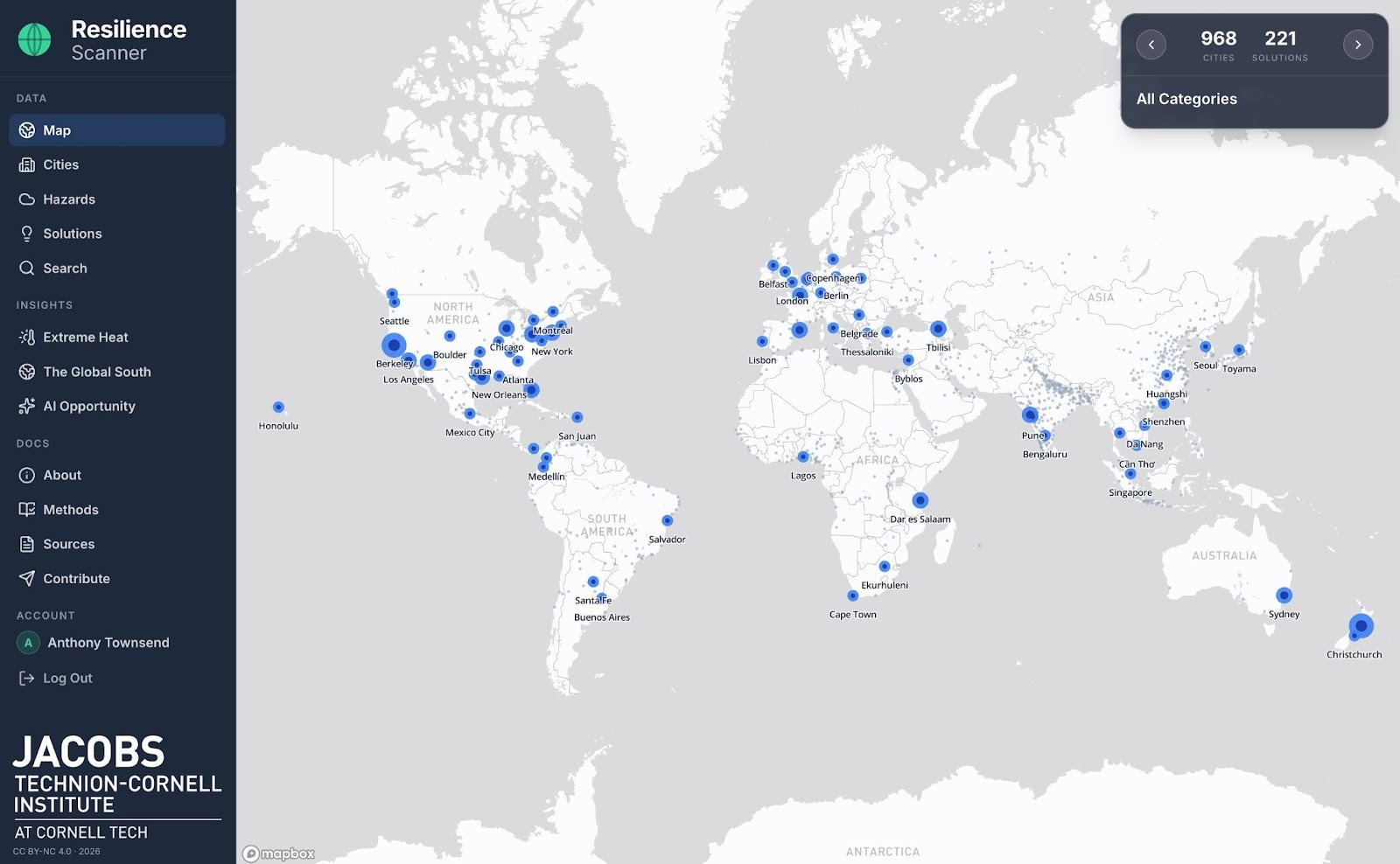
This work started with what I’ll admit was a wildly ambitious premise: what if we tasked an LLM with reading all the world’s urban resilience plans and identifying where technology was being called for? From there, we layered in deep research bots to scour the web, expand those raw findings into full case studies, and keep them updated as cities act.
Resilience Scanner now holds more than 220 AI-researched case studies of tech-enabled climate adaptation solutions across more than 100 cities worldwide. The knowledge is searchable by hazard, city, and solution type. We’ve also built tools to help planners identify opportunities to make tech transferable between cities with similar hazard profiles — if Phoenix is struggling with extreme heat and Adelaide has been running a promising cool-corridor program for five years, that match should be obvious and instant, not buried.
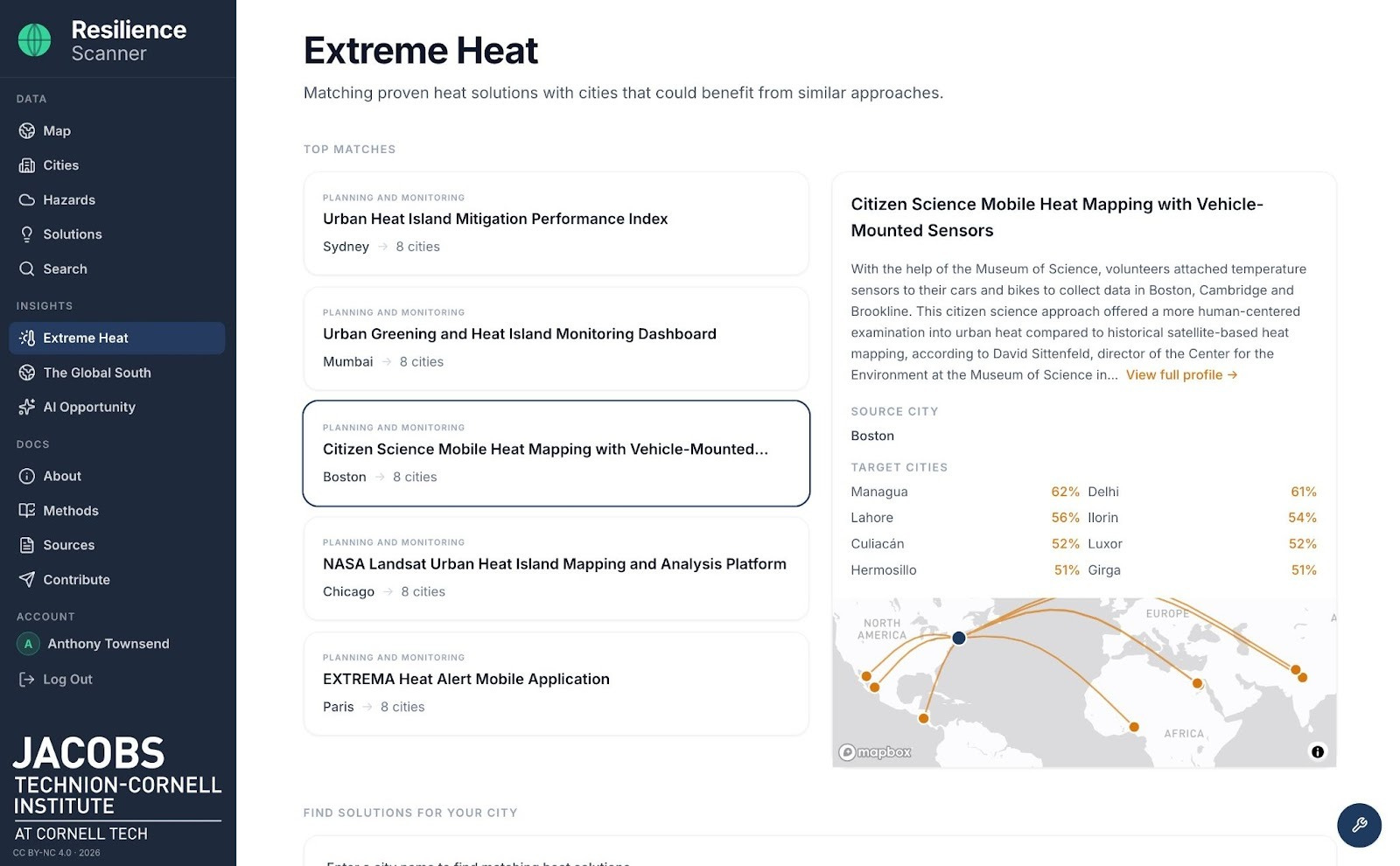
This isn’t just about making the most of public spending. As a wave of reports over the last year highlight, climate adaptation spending is far behind what’s needed. The bulk of that ground will have to be made up by private investors. But private investors are having a tough time finding the evidence of effectiveness they need. Resilience Scanner can help close that gap, and help surface bankable projects. To that end, we’re building tools to demonstrate where existing solutions deployed over the last decade could benefit from the latest AI innovations. These proven deployments, in cities where tech is already part of the toolkit, are ideal starting points for future innovations.
We launched the platform publicly on February 10th with a roundtable — Closing the Climate Adaptation Gap: How AI Can Connect Cities, Investors, and Innovators — moderated by Climate Proof’s Louie Woodall, with a sharp panel of experts including Laura Fox of Streetlife Ventures, Linda Shi from Cornell, Andrew Salkin of Resilient Cities Catalyst, and Natalia Moudrak from Aon. The conversation was, frankly, one of the best I’ve been part of on this topic.
A few moments that stuck with me. Andrew Salkin put the information problem in visceral terms: “I was reading the budget for a county I’m going to visit next week — it’s an 892-page PDF with no summary. The climate hazard plan is another 542-page PDF.” That’s not an edge case. That’s the norm. The knowledge exists; it’s just completely inaccessible.
Laura Fox reframed where we should be looking for adaptation demand: “The World Economic Forum estimates $4 trillion in corporate P&L loss over the next three years. We spend a lot of time talking about flooding and wildfires, but 70% of corporate losses from climate are expected from extreme heat.” Heat keeps getting underestimated, even as it keeps killing people.
Natalia Moudrak grounded the whole conversation in financial stakes: “In 9 out of the past 10 years, total economic losses from natural disasters exceeded $300 billion worldwide. Physical climate risk is a financial risk. If risks are not mitigated, you may end up with uninsurable, uninvestable, stranded assets over time.” Despite 10:1 returns on adaptation investment, a $359 billion annual funding gap persists — and a big reason is that investors simply can’t see what’s working.
And Linda Shi offered the sharpest reality check of the afternoon: “AI is accelerating our capacity for processing data, but it is not yet accelerating our capacity to engage in collaboration, shared governance, and trust building.” This is the tension at the heart of everything we’re trying to do, and I think it’s exactly right. The tool can surface the knowledge. The hard work of applying it is still human.
Finally, Jonathan Weitz framed the ultimate opportunity: “This is not a challenge of a lack of technology. This is really a systems problem — and there’s a $2 trillion market potential for climate adaptation solutions if we can solve it.”
This is just the beginning. With support from the Cornell Atkinson Center for Sustainability 2030 Project, we’re continuing to build out our research capacity. By mid-2026, we plan to expand coverage to the 1,000 largest cities by population, with thousands of case studies. Right now we’re focused on tech-enabled solutions, but the platform can support the much broader universe of adaptation actions cities are taking — and we hope to get there soon.
Resilience Scanner is open now. If you’re a planner looking for proven solutions, an investor trying to find bankable adaptation projects, or a technologist building tools that cities need — explore the platform and tell us what’s missing. The knowledge gap is a solvable problem, but only if the people who need this information help shape how it’s delivered.
→ Watch the full roundtable recording
Resilience Scanner is a recipient of a Cornell Atkinson Center for Sustainability 2030 Fast Grant.